

Q&A
Vrinda Sahai, Nicolas Köhler-Suzuki

Source: Getty
This piece argues that India’s central challenge is not managing a single flashpoint but resolving the underlying tension between expansion and institutional coherency of the BRICS grouping.
As BRICS chair in 2026, India aims to redefine it as “Building Resilience and Innovation for Cooperation and Sustainability,” anchored in a people-centric and humanity-first vision. At the launch of the summit logo in January 2026, External Affairs Minister S. Jaishankar stated, “India views BRICS as a constructive platform for dialogue and development, complementing the broader multilateral system.” As the group becomes increasingly heterogenous, New Delhi has inherited a presidency that confronts several unresolved challenges—mounting tariff pressures, stalled currency diversification mechanisms, an undercapitalized New Development Bank (NDB), and a membership process without defined rules.
This piece argues that India’s central challenge is not managing a single flashpoint but resolving the underlying tension between expansion and institutional coherency. This tension is found across three structural fronts: intra-bloc trade, the institutional credibility of the NDB, and membership.
BRICS emerged in the mid-2000s as a vehicle for emerging economies to secure a greater voice within global financial governance, advocating adjustments to Bretton Woods institutions, expanded voting rights for developing economies, and a more representative multilateral order. These goals are aimed toward advancing the voices of developing countries, especially in the context of the dominance of developed nations at international organizations, particularly the United Nations Security Council, International Monetary Fund, and World Bank. The grouping has continued to prioritize the concerns of developing countries that reduce dependence on developed countries (see Figure 1). Institutionally, BRICS has produced tangible outcomes, most notably the New Development Bank, designed to complement existing international financial institutions.
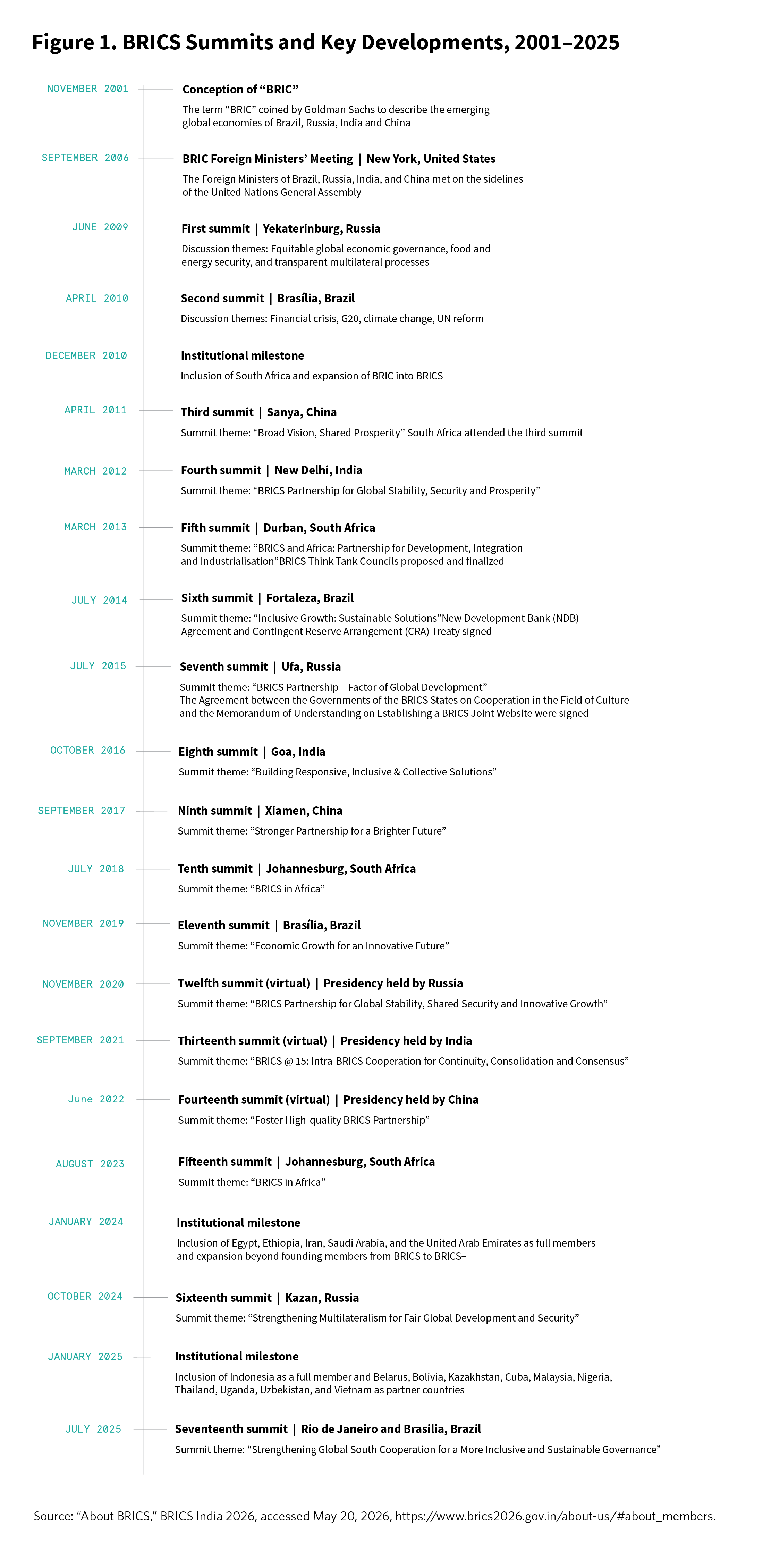
Brazil’s 2025 presidency reflected minimal institutional consistency. The momentum on economic priorities such as local currency trade mechanisms and development of the Contingent Reserve Arrangement, as established during Russia’s 2024 presidency, notably slowed. Positioned between its G20 (in 2024) and COP30 (in 2025) presidencies, the Rio declaration echoed the priorities reflected in the G20 and COP30 statements. Nationally, Brazil emphasized trade facilitation, climate finance, and public health cooperation. Additionally, it responded to the tariff pressures from the United States in 2025 (see table 1) through bilateral channels rather than coordinated bloc-level posture.
India, therefore, has inherited a platform of incremental progress and challenges with consolidation within the bloc. Critically, India can find the best balance by encouraging intra-bloc trade, strengthening the NDB, and providing institutional clarity on membership.
Intra-BRICS trade remains structurally underdeveloped. According to the United Nations Conference on Trade and Development (UNCTAD), although over two-thirds of the Global South’s gross domestic product (GDP) comes from BRICS members, only about 20 percent of South–South trade is intra-BRICS. This underscores the potential that can be achieved with easier intra-bloc trade mechanisms.
Though the trade architecture encourages the strengthening of national currencies to reduce dependency on the U.S. dollar, it is mostly bilateral. Two distinct patterns are evident in intra-bloc trade. First, as the largest importer and exporter among member nations, China remains central to intra-bloc trade. The major composition of trade includes primary commodities and higher-value manufactured goods. At the fifteenth BRICS trade ministers’ meeting, India called for dismantling of export controls among members to enhance trade volumes.
Second, while the BRICS countries continue to use the U.S. dollar as a reserve currency, there is a greater push for gradually reducing dependency on the U.S. dollar by trading in national currencies, however, there is no serious effort to establish a BRICS currency. It is notable that 99 percent (as of November 2025) of China and Russia’s bilateral trade is done using the ruble and yuan. Further, the Standard Bank in South Africa, has linked directly to China’s Cross-Border Interbank Payment System (CIPS, launched in 2015) allowing businesses to settle payments with China directly in renminbi without intermediary conversion to the U.S. dollar. Russia’s System for Transfer of Financial Messages (SPFS, launched in 2014) partners with 177 financial institutions across twenty-four countries (as of 2024). However, given that the CIPS and SPFS are recent establishments, they are far from competing with institutions such as the SWIFT (established in 1973) which connects with over 11,000 banks worldwide. While the U.S. dollar remains deeply entrenched as the primary reserve currency (comprising 57 percent of global foreign exchange reserves, as of September 2025), BRICS nations aim to gradually build resilience through such alternate systems which they participate through bilateral arrangements, although any transition away from the dollar is likely to remain slow and incremental.
The NDB operates within the global financial framework with the aim of maintaining and enhancing credit worthiness. Presently, it has six non-BRICS member states and is open to all UN member nations. NDB remains undercapitalized with a modest $100 billion capital base and no indication of future investments. Expanding this will require greater membership support and enhanced faith in its creditworthiness. A key concern for the bank is its expansion and strengthening of its role as a “platform for cooperation,” as stated by NDB president, Dilma Rousseff. She argues that this would entail increased participation in co-financing with other multilateral financial institutions and development banks.
The bank’s strength also lies in its willingness and ability to grant loans and provide financing in national currencies, thereby reducing exchange rate risks (see figures 1 and 2). As of December 31, 2022, NDB approved $42.9 billion financing for 139 projects. These include targets such as the installation of 2,400 MW renewable and clean energy generation capacity, the construction of 35,000 housing units, and upgrade of 1,400 km water tunnel/canal infrastructure. It also aims to avoid 14.7 million tonnes of CO2 emissions. Between 2022 and 2025, NDB approved forty-five projects in developmental areas, including clean energy and energy transition, transport infrastructure, water and sanitation, environmental protection, social infrastructure, and digital infrastructure.
Expanding lending capacities and increasing shareholding will contribute to enhancing the NDB’s creditworthiness and capital base. Notably, the establishment of BRICS Multilateral Guarantee Initiative, introduced at the 2025 summit in Rio, will also enable tailored instruments to de-risk strategic investment and improve creditworthiness in developing economies.
The expansion of BRICS could strengthen the bloc to operate beyond Western-dominated global financial frameworks, particularly, by reducing dependence on the U.S. dollar. However, this has been a continued point of contention among member nations. Critically, the criteria for membership are undefined. This BRICS expansion has resulted in the formation of a middle layer of strategic partners, where countries that are not full members are connected to the group through institutional or economic partnerships but their role within the bloc remains unclear. Arriving at a consensus also becomes increasingly difficult with such an expanded grouping.
Saudi Arabia’s inclusion in BRICS has been the most protracted case. It was officially invited to join in 2023, along with Argentina (which declined the invitation), Egypt, Ethiopia, Iran, and the United Arab Emirates. Though it has not formally accepted the invitation, Saudi Arabia has steadily participated in the bloc’s discussions, including at the Rio Summit in 2025. While it aligns with the group’s economic and developmental priorities, it continues to balance against a perception of strategic alignment with the other members. Constructive and selected engagement on key priorities remains the way forward in 2026.
Iran’s membership has also been a topic of increasing contestation. Strategically, Iran’s membership at BRICS enables greater engagement opportunities for India, particularly given its energy security priorities and the future of the Chabahar port.[1] In the context of the 2026 West Asia crisis, though the bloc did not release an official statement, India expressed concern for the escalation in the region and called for respect of territorial sovereignty. The Ministry of External Affairs (MEA) stated on March 14, 2026, “Some members of the BRICS are directly involved in the current situation in the West Asia region, which has impacted forging a consensus on a common BRICS position on the ongoing conflict. As Chair of BRICS, India has been facilitating discussions among members through [the] Sherpa channel.” India welcomed the ceasefire on April 8, 2026, especially addressing the global energy supply and trade disruptions, and issued a statement regarding a shooting incident involving Indian-flagged ships in the Strait of Hormuz. This is in contrast with Brazil’s presidency in 2025 when the bloc collectively addressed the West Asian crisis in a joint statement and the official Rio Declaration, condemning Israeli strikes in Iran, when other West Asian countries and BRICS members/partners were not directly involved in the crisis.
Thus, arriving at a consensus on BRICS membership remains a persistent problem. In fact, new expansion is currently not expected as the group prioritizes full “integration of members and partners in BRICS activities.”
Expectations from within and outside the bloc often exceed what the grouping can realistically deliver. With increasing visibility, BRICS remains a complex and heterogeneous grouping, lacking clearly defined mechanisms for membership, consensus-building, and credible financial procedures. The current crisis in West Asia is reshaping the landscape for the BRICS, creating a new normal where internal coherence is increasingly difficult to achieve. Given the involvement of member states in the crisis, consensus within the bloc is more complex and contested.
India hosted the Foreign Ministers’ Meeting on May 14–15, 2026. Most members were represented at the foreign minister level; the Chinese ambassador to India and the Vice Minister of Foreign Affairs of Saudi Arabia represented their countries. In his national statement, Jaishankar laid particular emphasis on the conflict in West Asia, highlighting the fragility of the situation and that “safe and unimpeded maritime flows through international waterways, including the Strait of Hormuz and Red Sea, remain vital for global economic well-being.” Further, in the statement on BRICS@20, he reaffirmed India’s commitment to strengthening the bloc “in line with principles of international understanding, solidarity, openness, inclusiveness, full consultation, and consensus.”
The difficulty in achieving consensus among members is evident in two instances. First, the Foreign Ministers’ Meeting did not produce an official joint statement, only a Chair’s statement and outcome document. Second, the chair’s statement mentioned reservations by members on three issues: differing views on the situation in West Asia/the Middle East region, the Gaza Strip as an inseparable part of the Occupied Palestinian Territory, and the navigational rights and freedoms of vessels of all states in the Red Sea and Bab Al-Mandab Strait under international law.
The persistent challenge for BRICS—and for India as its chair—is to define its role as an expanded heterogenous group. Divisions in the face of “unprecedented geopolitical and economic uncertainty” are evident. The outcomes of the summit in September will no doubt depend on developments following the Foreign Ministers’ Meeting and the evolving global and regional fault lines.
[1] The extent of India’s participation in the Chabahar project is unclear. According to the Ministry of External Affairs, India has fulfilled its financial commitment for the procurement of port equipment and there was no budget allocation for the port for FY 2026–27.

Research Analyst, Security Studies Program
Vrinda Sahai is a research analyst in the Security Studies Program at Carnegie India. Her work focuses on Indian foreign and security policy, particularly, India’s strategic partnerships and relations with major powers.
Recent Work
Vrinda Sahai, Nicolas Köhler-Suzuki
Carnegie India does not take institutional positions on public policy issues; the views represented herein are those of the author(s) and do not necessarily reflect the views of Carnegie, its staff, or its trustees.

In any defense establishment, change is an ongoing process. However, despite the best of intentions, existing bureaucracies, bound by habit and years of socialization, have their limits in implementing transformative change.

Anit Mukherjee

As AI grows more sophisticated, as the supply chains that power it become more contested, and as access to frontier models becomes geopolitically charged, India must begin to ask a different set of questions. Not what applications it can build on someone else’s infrastructure but what the world needs.

Konark Bhandari

The Indian Ocean Region hosts one of the densest concentrations of subsea cables in the world. Yet, despite accounting for a significant share of global internet traffic, India’s participation remains limited.

Charukeshi Bhatt

How is AI reshaping space security, creating governance challenges, and where does international diplomacy stand today?


Tejas Bharadwaj, Almudena Azcárate Ortega

After the chill in ties between 2020 and 2024 that brought India–China relations to their lowest point in several decades, the two countries have engaged each other afresh. This paper argues that there are predominantly four imperatives guiding India’s approach to China, and they exist in an order of priority.

Saheb Singh Chadha